The main points
- Ninety minutes over uneven lava, both ways. The descent asks almost nothing.
- Stated by the operator. Nothing drives to the crater.
- If you turn round half way, you are walking half way.
- Where no rule is published, this page will not invent one.
The thing that actually decides it
People approach this question backwards. They worry about being lowered into a hole and they do not think about the three kilometres of walking that comes first.
Physically, the descent asks nothing. You stand on a platform holding a rail while a winch does the work, and then you stand on a slope for an hour. A person of any age and almost any fitness can do that part.
The walk is a different proposition. Forty-five to fifty minutes each way across a four-thousand-year-old lava flow under a thick moss blanket. It is not steep and it is not fast, and every single step is on ground that is slightly different from the last, which is tiring in a way that flat distance is not.
So the honest test is not whether you are brave. It is whether ninety minutes of uneven walking, in whatever the weather is doing, sounds like something you would do on purpose.
The published restriction
The operator rules the trip out for anyone with limited mobility, and that is a description of the terrain rather than a piece of legal boilerplate.
It follows from the geography. There is no road to the crater, no vehicle access of any kind, and no shortened route. The only way to the opening is the same walk everybody else does, and there is no arrangement that gets around it.
This is worth taking at face value. A person who can manage a paved trail comfortably and struggles on rough ground is going to have a very long morning, and the point at which that becomes obvious is a long way from the cabin.
Knees, backs and ankles
This is the commonest specific question and the answer is nuanced rather than a yes or a no.
The ground is the issue. Uneven lava under moss means constant small ankle adjustments and occasional larger steps up and down over blocks. That is harder on a bad knee than a steady gradient would be, and it is harder on an ankle than any amount of distance on a path.
There is no significant descent on the walk, which helps, since downhill is what usually punishes knees. And boots with real ankle support make a genuine difference here rather than a marginal one, which is part of why the operator is so specific about footwear.
Walking poles are not mentioned in the booking and would not be unreasonable on this ground if you use them normally.
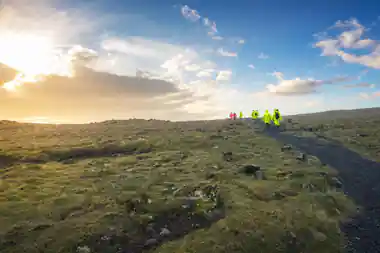
The path across the lava field towards the cones
Hearts, lungs and cold
The exertion is moderate and sustained rather than intense. There is no climbing to speak of and no need to hurry. On that basis alone it is a gentler outing than the phrase volcano hike suggests.
The complicating factor is cold. You walk and get warm, then stand at an exposed rim in wind for an indefinite wait, then stand still in a chamber that has been cold for four thousand years, then walk again. That cycling between exertion and standing about in cold air is more demanding on the cardiovascular system than either would be alone.
Anyone managing a heart or respiratory condition should treat this as a question for their own doctor rather than for a tour operator or a website. Neither of us knows anything useful about your particular case, and the honest answer is to ask someone who does.
Pregnancy, and other cases with no published rule
The operator publishes no pregnancy rule for this tour, and this site is not going to write one on its behalf.
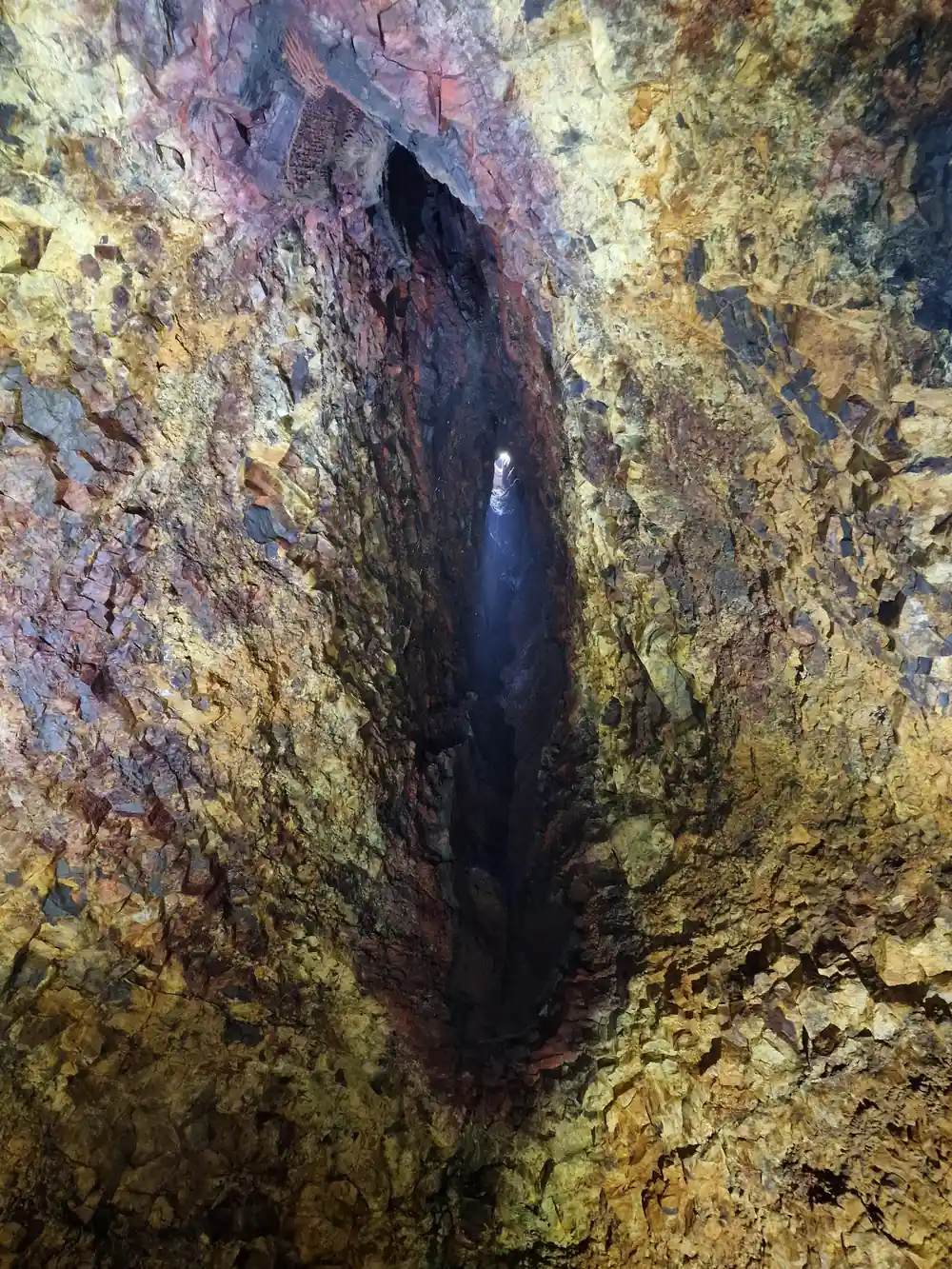
What can be said factually is what the day involves: ninety minutes on uneven ground with no vehicle access and no quick way back, an open platform on a winch, an hour standing on a loose slope in the cold, and a total of six hours away from anywhere.
That is the information a medical professional would want, and it is the right basis for a decision. If you want a definitive answer from the operator rather than an inference, ask them at the time of booking. They answer this sort of question routinely and their answer is authoritative in a way that a page like this one is not.
If you are genuinely unsure
Two useful tests. First: have you comfortably walked for ninety minutes on rough natural ground in the last year? If yes, this is well within you. If it has been a while, it is a moderate rather than easy day.
Second: are you comfortable on an open platform with a rail, at height? The chamber is not claustrophobic, but the access is unambiguously exposed, and being willing on the morning does not alter it.
It is also worth separating the two questions people tend to merge. Being physically able to do the day and wanting to stand on an open platform are unrelated, and a person can pass one comfortably and fail the other. Answer them one at a time rather than as a single feeling about whether this is for you.
Free cancellation on the booking gives you room to decide, and the operator would far rather answer a question in advance than have somebody turn back at the crater. Ask them. It takes a moment and it is what they are there for.
If ninety minutes on rough ground is fine, so is the rest
from US$432Reserve now & pay later